The Approach
Power tools in the workshop
Hand tool woodworking is not a romantic affectation. It is a discipline — one that demands more from the maker, and gives more back to the work.
Every cut made by hand is a cut the maker feels. You know when the saw is drifting before it shows on the wood. You know when a chisel is blunt before it tears the grain. That sensory feedback loop — between hand, tool, and material — is what keeps the work honest.
Power tools abstract that away. They're fast, consistent, and completely disconnected from what the wood is actually doing. The router doesn't care that it's running against the grain. The machine doesn't feel the timber shift when humidity changes. The maker has to stay present — and that presence is what ends up in the finished piece.
"There is a specific quality of attention that hand tool work demands. You can't zone out with a sharp chisel. That attention — that being properly there — is exactly what good joinery requires."
The workshop holds everything needed and nothing that isn't. A bench, saws kept sharp, chisels that will shave hair, a few planes, and the particular quiet that comes from working without motors. That's where every piece starts — and where the real decisions get made.
The Arsenal
Every tool earns its place. Here's what does the work — and why each one matters.
Made in Warren, Maine, by dedicated toolmakers committed to reviving the highest standards of the 19th century. Heavy enough to start the cut with its own weight, aggressive enough to track through hardwood with speed, and refined enough to produce a joint that fits perfectly off the saw. Swedish steel, precision-set and hand-filed. These are tools made by people who understand what a saw is for
Pull-cut, thin kerf, crosscut teeth ground to a mirror edge. Used for any cut where precision matters most — joinery lines, shoulder cuts, tenon cheeks. The pull stroke means the blade is in tension rather than compression: a straighter, cleaner cut with almost no effort. Once you understand how a pull saw works, pushing a Western saw for fine work feels like a step backwards.
The kiridashi is a single-bevel Japanese marking knife — asymmetric, very thin, used to scribe a line you can register a chisel into. It cuts across grain fibres rather than crushing them. The marking gauge is set once and not touched until the job is done. Lines cut with these tools are the only reference points that matter. Everything downstream works back to them.
Made in Sheffield, England, by a family-owned company that has been forging fine edge tools since 1885. Balanced enough to provide exceptional control, aggressive enough to remove material with ease, and refined enough to take a razor-sharp edge that glides through timber. Sheffield O1 carbon steel, expertly heat-treated. These are tools made by people who understand what a chisel is for.
Used for flattening boards, shooting end grain, and final surface preparation. A tuned bench plane set fine leaves a surface that needs no sanding — just oil. The shoulder plane comes out for fitting tenons and refining rebates: a tool for removing a single shaving at a time from one specific surface. No router jig produces a tenon cheek as clean as a shoulder plane does.
The card scraper is the last tool before oil. Burnished to a fine hook, it removes plane tracks on difficult grain and brings figured timber to a quiet lustre without the tear-out a plane would cause. Then danish oil — two to three coats, burnished back between each. It penetrates rather than coats. The finish deepens over years. It feeds the timber rather than covering it.
The Method
From the first selection of timber to the last coat of oil, every stage is deliberate. What gets considered, what gets tested, and what never gets rushed.
A board is chosen for grain character, figure, and stability — then stickered with spacers between each piece and left to equalise to the workshop's humidity before any cuts are made. Wood that hasn't settled will move after joinery. Joints that were tight become loose. The wait is not patience for its own sake. It is physics.
Before anything is measured, the board is planed true — a flat face side and a square face edge. These are the two reference surfaces that every subsequent measurement and cut works from. A winding board checks for twist. A straightedge checks for hollow or bow. If the references aren't right, nothing downstream can be.
Dimensions are transferred with a marking gauge, set once and left set. Joinery lines are scribed with the kiridashi — a cut, not a scratch, that severs the surface fibres cleanly. The saw splits these lines. The chisel registers into them. Every subsequent step works back to these marks. They are the piece's skeleton.
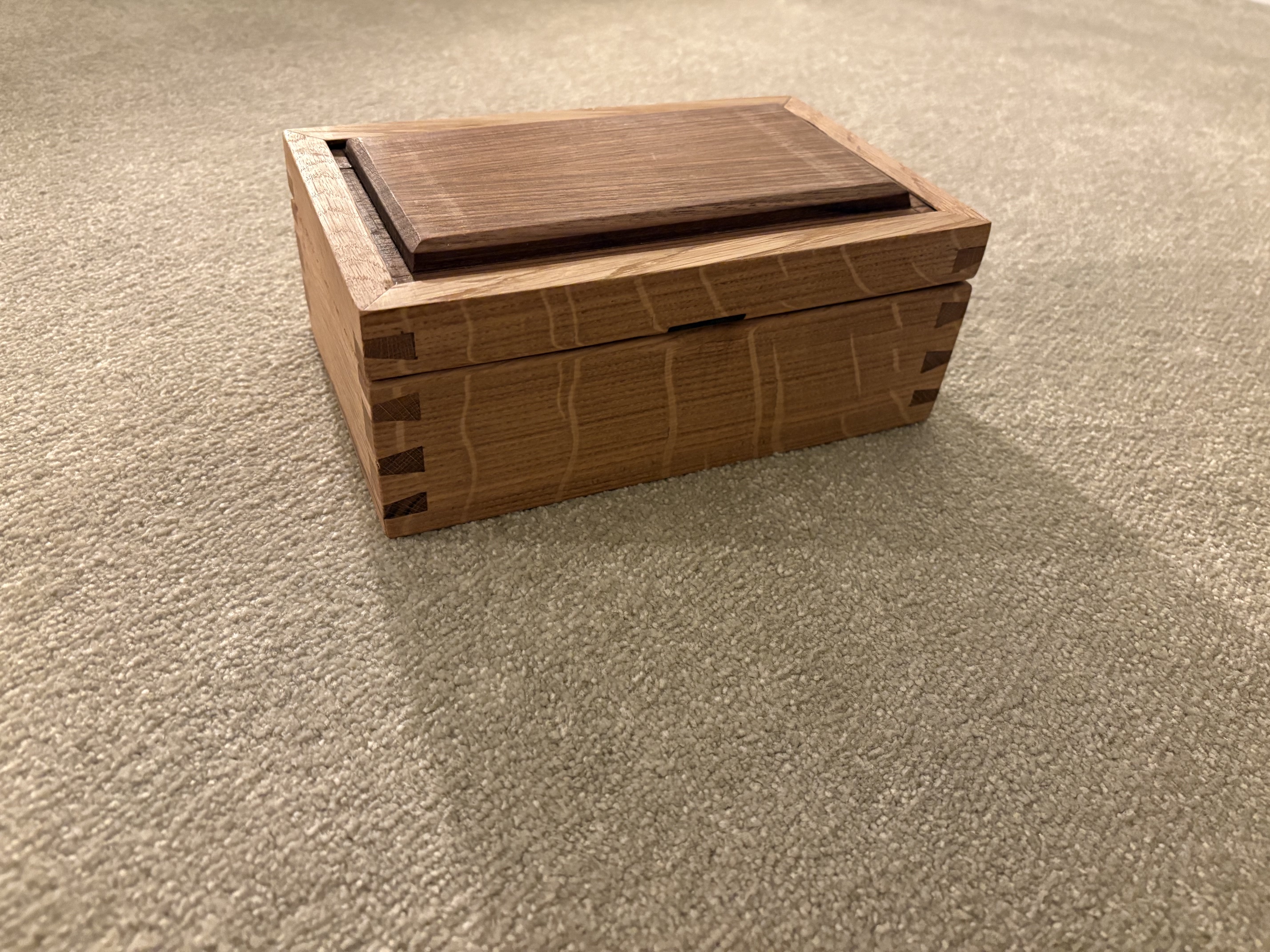
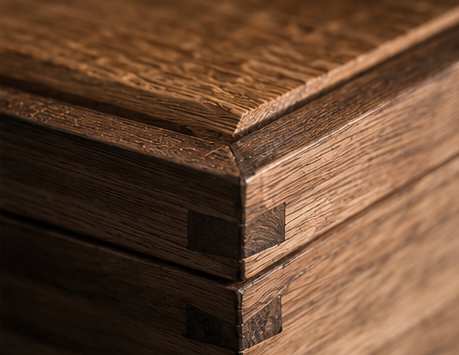
Dovetails are laid out with a sliding bevel at 1:8 for hardwoods and cut with the Lie Nielsen dovetail saw. Waste is removed with a coping saw, then pared back to the line. Tails are cut first, then pins marked directly from the tails — not from a template. This guarantees a fit regardless of minor variation in the saw cuts. The joint is made to the wood, not to a drawing.
The joint is assembled dry and inspected. A correct fit requires light mallet pressure to close. Any binding is located by bluing the joint, and a single shaving is removed with a paring chisel. Repeated until the joint closes under hand pressure alone, fully seated, with no gaps on the show face. Only then does glue go on.
Glue is cleaned while still green. Surfaces are brought flat with a finely-set hand plane, then worked with a card scraper. No sandpaper on show surfaces — sanding scratches hold oil differently and show under raking light. The scraper leaves a surface that takes oil evenly and builds a finish that ages with the piece rather than sitting on top of it.
Timber
Dense, dark, and close-grained. Takes an edge tool beautifully and holds joinery detail with precision. The heartwood deepens with age and oil.
Pale background, bold growth rings, and a hardness that rewards a sharp plane. Exceptional contrast in dovetailed pieces — the joint reads clearly against the grain.
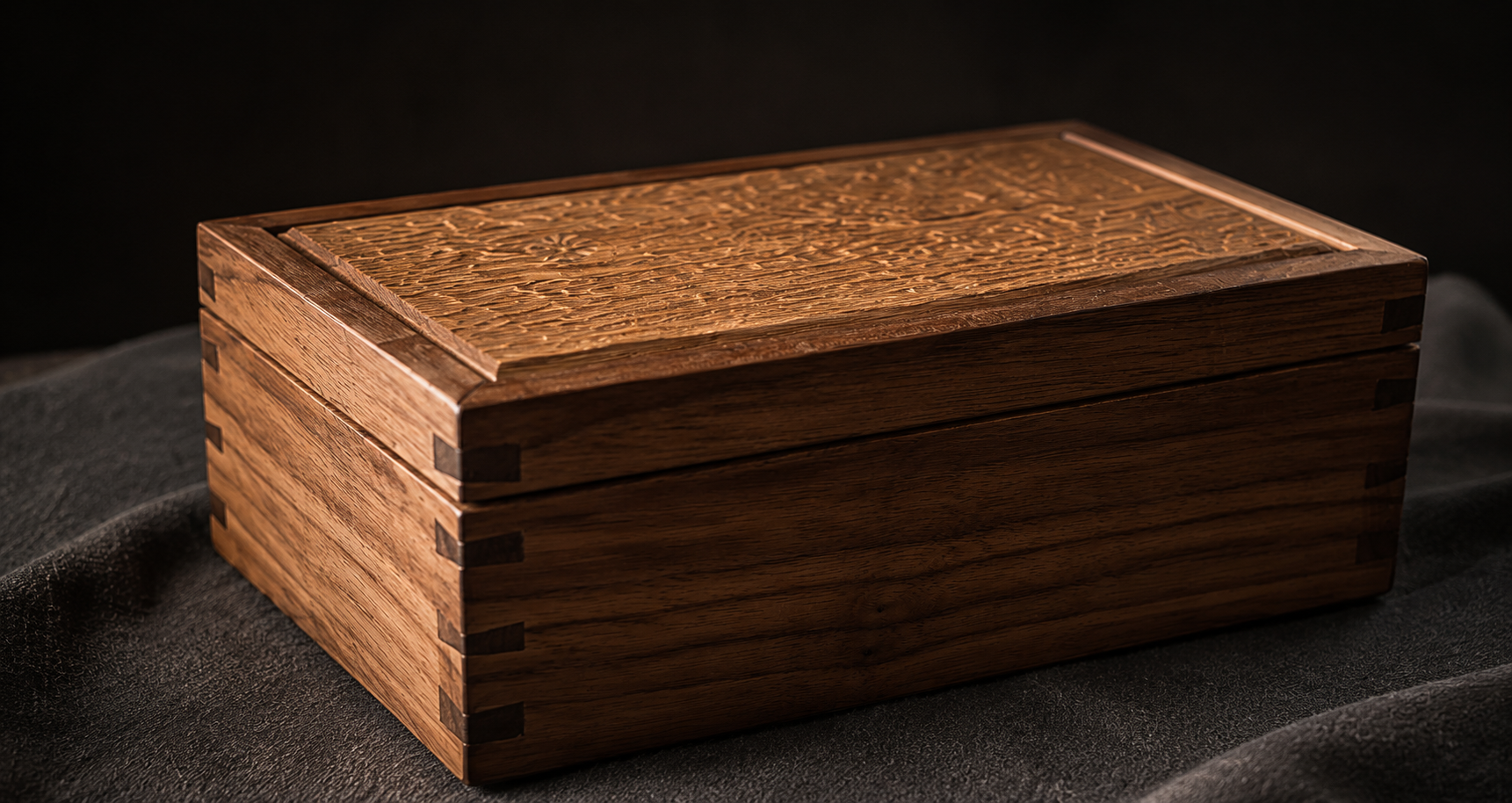
The most English of timbers. Dense and characterful. Ray fleck in quarter-sawn stock is a decorative feature in its own right. Built to last centuries.
Fine-grained and smooth under a plane. New cherry is warm pink-brown; aged cherry turns a deep amber that no stain can replicate.
Timber is not a commodity in this workshop. The same species from two different trees, felled at different times in different forests, will produce entirely different results. Grain direction, growth ring spacing, figure, and moisture content all affect how the wood cuts, how it moves, and how it finishes. Every board is selected by hand and for a reason.
Boards are stickered and given time to acclimatise before they're touched. Wood that hasn't settled will continue to move after assembly. A lid that fits perfectly in summer might bind in winter if the timber wasn't allowed to find its equilibrium first. The wait is part of the process. It always has been.
The Rules
Commission
Every commission starts with a conversation about the piece — the timber, the joinery, the purpose. There's no catalogue. Just the work, made properly, for the person who asked for it.